


At a glance
| AI transcription | Software generates a full draft in minutes; you review and correct it |
|---|---|
| Human transcription | A person (often a service) types and checks the audio; slower, higher cost |
| Turnaround | AI: minutes. Human: hours to days depending on the service and queue |
| Best for AI | Meetings, interviews, lectures, voice notes, research where you review the draft |
| Best for human | Certified, verbatim, or court/medical records where a signed transcript is required |
| Accuracy | Neither is a fixed percentage — it depends on audio quality, accents, and crosstalk |
| TranscribeThis | AI, post-recording: first 5 minutes free (no account), then review and export |
Quick decision table
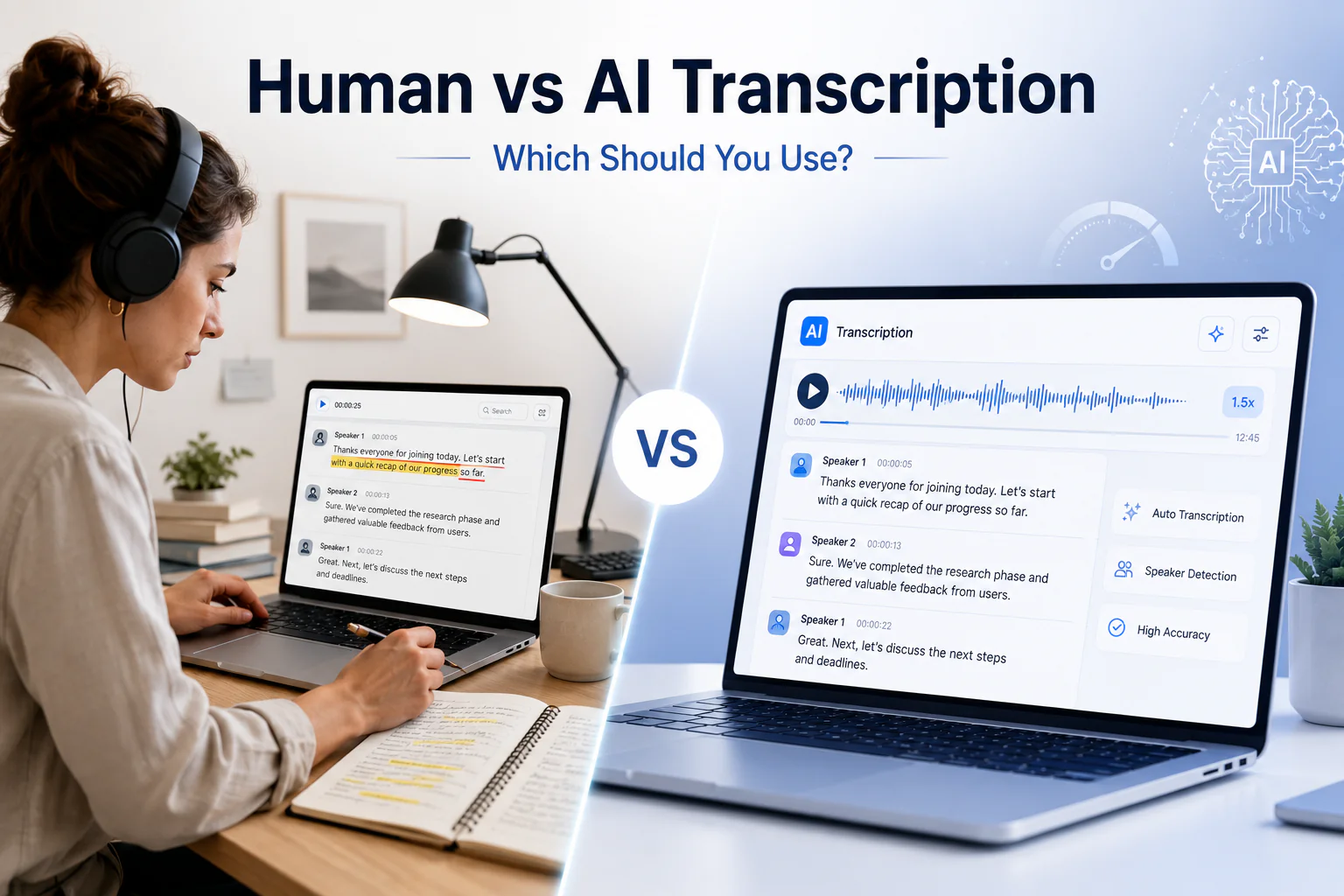
AI and human transcription are two different products, not two brands of the same thing. AI is software that produces a draft you review; human transcription is a service where a person listens and types, and can certify the result. Use the criteria below to decide which category fits your recording, then pick a specific tool or service.
| Dimension | AI transcription | Human transcription |
|---|---|---|
| Turnaround | Minutes for most files | Hours to days, depending on service and queue |
| Cost model | Low, usually per-minute or a subscription | Higher, priced per audio minute or per job |
| Review effort | You review and correct the draft yourself | Reviewed by the transcriber before delivery |
| Speaker complexity | Handles clear turns well; overlap is hard | A person can untangle crosstalk and unclear speech |
| Confidentiality | No human reads it if you keep it in-tool; check vendor terms | A person hears the audio; confirm NDAs and handling |
| Certification | Not certified — it is a draft | Can be certified/verbatim where the service offers it |
| Consequential use | Fine once you verify the parts that matter | Preferred when errors carry legal or clinical risk |
What AI transcription does well
AI transcription is the fastest way to turn a recording into editable text, and it is strongest on ordinary conversational speech. For most everyday needs, a machine draft plus a focused review is quicker and more consistent than typing from scratch.
- Speed — a full draft in minutes instead of the real-time-plus of manual typing.
- Cost — low per-minute or subscription pricing makes high volume practical.
- Consistency — the same file transcribes the same way every time.
- Search and reuse — the draft is immediately editable, searchable, and exportable to TXT, DOCX, PDF, SRT, or VTT.
- Word-level timestamps on uploads and recordings, so you can click a word to hear it and verify quickly.
Illustrative example. A researcher with ten hour-long interviews can get drafts of all of them in an afternoon, then spend review time only on the passages they plan to quote — far faster than transcribing each one by hand.
When human review adds value
A human transcriber earns their cost when the audio is hard or the stakes are high. People can use context, disambiguate homophones, untangle overlapping speakers, and flag genuinely unclear passages instead of guessing.
- Heavy accents, dialect, or non-native speech that trips up automatic recognition.
- Crosstalk and overlapping speakers — the single hardest case for any model.
- Poor recordings: distant mics, background noise, or low-bitrate phone audio.
- Specialist vocabulary where a mis-heard term changes the meaning.
- Situations where an unclear passage must be marked as unclear, not filled in confidently.
Accuracy is not a single percentage
No transcription method has one fixed accuracy number, and any headline figure — from an AI vendor or a human service — is a best case, not a promise for your file. Accuracy depends far more on the recording than on the method.
- Clear, single-speaker audio transcribes very well with either approach.
- Accents, crosstalk, music, and phone recordings raise the error rate for both.
- The costly errors are usually specific: names, numbers, dates, and jargon — the things a model cannot infer from context.
The practical takeaway: judge accuracy by testing your own audio, not by comparing quoted percentages. Whatever method you choose, review the parts you will quote or act on.
Cost and turnaround
The two categories sit at opposite ends of the cost-and-speed trade-off, and the pricing models differ in kind — not just amount.
| Model | How it is usually priced | Typical turnaround |
|---|---|---|
| AI subscription | Flat monthly fee with usage limits | Minutes |
| AI per-minute | Charged per minute of audio processed | Minutes |
| Human per-minute | Charged per minute of audio, higher rate | Hours to days |
| Human certified/rush | Premium per minute for certification or speed | Longer, or rush surcharge |
Pricing and plans change frequently — confirm exact numbers on the current pricing page of whatever tool or service you are considering. Also factor in the hidden cost of review time: a cheap AI draft still needs your attention, and a human service still needs a final read on your side.
Certified, verbatim, and court-ready outputs
When a transcript must be certified, verbatim, or admissible, that is a human-service requirement, not an AI feature. A certified transcript is a signed attestation that the text matches the audio — something software cannot provide on its own.
- Certified transcript — a person attests, in writing, that it is accurate. AI drafts are not certified.
- Verbatim transcript — every "um", false start, and interruption captured exactly, usually a human deliverable.
- Court-ready or evidentiary — check the requirements of the specific court or body; these typically demand a certified human transcript.
Use cases: research, journalism, legal, medical, media
The right choice usually follows from the field and how the transcript will be used. In most of these, an AI draft is the working tool, and human certification enters only when a signed record is required.
| Field | Typical fit | Why |
|---|---|---|
| Research / academia | AI draft + your review | Volume of interviews; you verify quotes you cite |
| Journalism | AI draft + your review | Speed matters; reporter checks anything published |
| Legal | Human, often certified | Certification and verbatim accuracy carry legal weight |
| Medical | Human or supervised workflow | Clinical errors are high-consequence; confirm compliance needs |
| Media / podcasting | AI draft + light edit | Captions and show notes reviewed before publishing |
Even where AI is the day-to-day tool, keep the review discipline: listen to any passage you will quote, act on, or publish. That single habit closes most of the gap between a draft and a dependable transcript.
Hybrid workflow: AI draft + human review
For most work the best answer is not one category or the other — it is both in sequence. Generate the AI draft first, then apply human review where it counts. This captures the speed of AI and the judgment of a person without paying for a full manual transcription.
- Upload or record the file and let the AI produce a complete draft in minutes.
- Scan for [inaudible] or low-confidence passages and fix those first.
- Play back and verify names, numbers, dates, and specialist terms — the errors that cause real damage.
- Correct speaker turns where people talk over each other.
- If the result must be certified or verbatim, hand the reviewed draft to a human service for the final, signed version.
On TranscribeThis this is the intended flow: the AI produces the draft, word-level timestamps let you jump to any moment, and you export once it reads correctly. The tool is the fast first pass; the human review is what makes the transcript dependable.
Privacy and vendor evaluation
Confidentiality is a real difference between the two categories: with AI the audio can stay in software, while a human service means a person hears it. Evaluate either option on how your content is handled, not on marketing claims.
- Who or what accesses the audio — software only, or a human transcriber under an NDA.
- Retention and deletion — how long files and transcripts are kept, and whether you can delete them.
- Training use — whether your content can be used to train models (prefer no-training terms).
- Transport and storage — encryption in transit is table stakes; at-rest specifics are provider-dependent, so ask.
- Consent — recording other people may require their consent depending on your jurisdiction.
Frequently Asked Questions
Human vs AI transcription — which is better?
Neither is universally better; they are different products. AI gives a fast draft you review, which suits most meetings, interviews, and research. Human transcription adds review and can certify the result, which matters for legal, medical, or verbatim needs. Choose by turnaround, cost, review effort, and how consequential an error would be.
When do I need a human transcription service?
When the transcript must be certified, verbatim, or court-ready, or when the audio is genuinely hard — heavy accents, crosstalk, or poor recordings — and errors would carry legal or clinical risk. In those cases a person's judgment and accountability are worth the higher cost and slower turnaround.
How accurate is AI transcription?
It depends on the recording, not on a single percentage. Clear, single-speaker audio transcribes very well; accents, overlapping speech, music, and phone recordings raise the error rate. Any quoted accuracy figure is a best case, so verify the names, numbers, and passages you plan to quote or act on.
Is automated transcription good enough for professional work?
For most professional work, yes — as a draft you review. Reporters, researchers, and teams use AI transcripts every day, then check anything they publish or rely on. It is not sufficient on its own where a certified or verbatim record is legally required.
Is human transcription always more accurate than AI?
No. "Human" does not automatically mean perfect; transcribers vary in skill, focus, and familiarity with the subject. The advantage is judgment on difficult audio and the ability to certify — not a guaranteed error-free result.
What is a certified transcript, and can AI produce one?
A certified transcript is a signed attestation that the text matches the audio, produced by a human service. AI tools cannot certify their output — an AI draft can speed the first pass, but a certified transcript is a separate human deliverable.
Can I combine AI and human transcription?
Yes, and it is often the best approach. Generate the AI draft in minutes, review names, numbers, and unclear passages, then send the reviewed draft to a human service if you need a certified or verbatim final version. You get the speed of AI and the judgment of a person.
How do I evaluate a transcription vendor for privacy?
Ask who or what accesses the audio, how long files and transcripts are retained, whether your content can be used to train models, and how data is encrypted in transit and at rest. With a human service, confirm NDAs and handling; with AI, confirm no-training terms and your ability to delete files.
Can I try AI transcription before deciding?
Yes. Upload a real file to the tool at the top of this page — without an account you can transcribe the first 5 minutes of a file up to 50 MB and see the draft quality on your own audio before choosing between AI and a human service.
Related resources
Reviewed by the TranscribeThis product team · Last updated: July 2026