


At a glance
| Common units | Per audio minute, per audio hour, monthly subscription, or credits |
|---|---|
| AI transcription | Cheapest per minute; you review the draft yourself |
| Human transcription | Priced per audio minute; slower, includes human editing |
| Certified / verbatim | A separate, higher-cost human service — not an AI product |
| Cost drivers | Turnaround, number of speakers, audio quality, timestamps, review level |
| TranscribeThis | Subscription model with a free preview tier — see /pricing for numbers |
Quick cost ranges
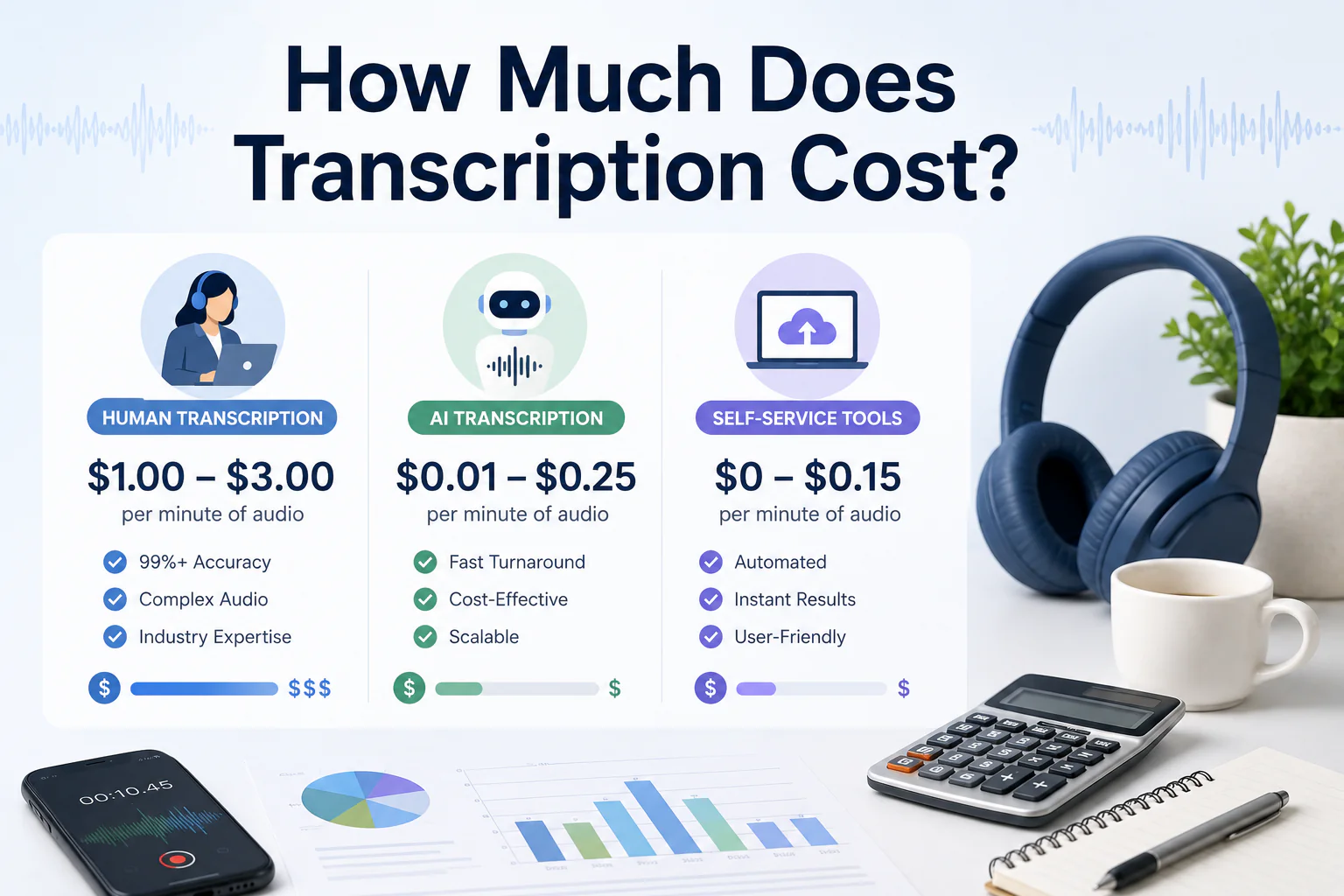
There is no single "price of transcription" because the market splits into two very different products with different cost curves. Automated (AI) transcription is priced low because a machine produces the draft and you do the reviewing; it is usually sold as a monthly subscription or a low per-minute rate. Human transcription is priced per audio minute because a person listens and types, so its cost scales with your audio length and the accuracy you require.
- AI transcription is the low end: pennies per minute, or a flat monthly plan with an included quota.
- Human transcription is the high end: a per-audio-minute fee that rises with turnaround, speakers, and verbatim/certification requirements.
- Certified, legal, or medical verbatim transcripts sit above general human transcription and are a distinct, regulated service.
Pricing models: per-minute, per-hour, subscription, credits
The pricing unit matters more than the sticker number, because it decides whether cost scales with your usage or stays flat. The four models below cover almost every transcription vendor. Match the model to how you actually work: bursty one-off projects favour per-minute, while steady weekly volume favours a subscription.
| Model | How you pay | Best when | Watch out for |
|---|---|---|---|
| Per audio minute | A rate multiplied by the length of your recording | Occasional one-off files | Costs scale directly with audio length; long files add up |
| Per audio hour | A rate per hour of audio (same idea, coarser unit) | Longer recordings like lectures or panels | Rounding up partial hours; add-ons billed separately |
| Monthly subscription | A flat fee with an included quota of minutes or files | Regular, predictable weekly volume | Overage charges and quotas that reset or expire |
| Credits / pay-as-you-go | Prepaid credits spent per job | Irregular usage you want to cap | Credits that expire; features that cost extra credits |
Illustrative example. A team that transcribes a few short clips per month may pay less on a per-minute tool, while a team transcribing several hours every week almost always pays less on a subscription with an included quota. Estimate your monthly audio volume before comparing any two prices.
AI transcription costs: what drives them
AI transcription is cheap per minute because the marginal cost of running a model is low, so vendors compete on subscription features rather than raw price. What actually changes your bill is not the per-minute rate but the plan tier you need to unlock the capabilities your workflow depends on.
- Plan tier: higher tiers raise file-size and duration limits and add speaker labels, exports, and team seats.
- Included quota: free and entry tiers usually cap minutes, files per day, or export access.
- Speaker labels (diarization) and word-level timestamps are often gated to paid tiers.
- Full export (DOCX, PDF, SRT, VTT) versus a preview-only free tier.
- Extras like translation, a meeting bot, or integrations may sit on higher plans.
Human transcription costs: what drives them
Human transcription is priced per audio minute because a person spends real time listening, typing, and correcting, so its cost is fundamentally labour. Anything that makes that labour harder or faster moves the price up or down. This is why human quotes vary so widely for the same length of audio.
| Cost driver | Effect on price |
|---|---|
| Turnaround time | Faster delivery costs more; standard turnaround is cheaper |
| Number of speakers | More speakers and crosstalk take longer to transcribe accurately |
| Audio quality | Noisy, muffled, or accented audio raises the per-minute rate |
| Verbatim vs clean | True verbatim (every "um", false start) costs more than a cleaned transcript |
| Timestamps | Frequent or per-word timestamping is often an add-on |
| Certification | Signed, certified, or legal transcripts carry a premium |
Difficult audio, multiple speakers, rush delivery
The three factors that most inflate a transcription bill are poor audio, many speakers, and a tight deadline — and they raise cost for both AI and human workflows, just in different ways. With AI the cost shows up as extra review time on your side; with a human service it shows up as a higher per-minute rate.
- Difficult audio: background noise, low volume, and heavy accents mean more correction (AI) or a higher rate (human).
- Multiple speakers: overlapping speech is the hardest case for any model and adds human labour; speaker labels are usually a paid AI feature.
- Rush delivery: same-day turnaround is a premium on human services; AI is fast by default but still needs your review time.
Certified and professional transcripts
Certified transcription is a different product from AI transcription, not just a more expensive version of it. A certified or verbatim transcript is produced and attested by a human for legal, medical, or official use, and it carries a premium for that accountability. An AI draft — however good — is not a certified record and should not be treated as one.
If you need a court-admissible, medical, or officially certified transcript, budget for a professional human service and its certification fee. If you need a fast, editable working transcript for meetings, interviews, research, or content, an AI tool plus a focused review is far cheaper and usually enough.
How to calculate your project cost
Estimate total cost with a simple formula rather than trusting a headline rate: work out your real monthly audio volume, add the features you actually need, then price the same job on each model. Plug current quotes from /pricing and from each vendor into the steps below.
- Measure your audio: total minutes or hours per month, and the length of a typical file.
- List required features: speaker labels, timestamps, export formats, translation, turnaround.
- Per-minute estimate = (audio minutes) × (vendor per-minute rate) + add-on fees.
- Subscription estimate = (monthly plan fee) + any overage once you exceed the included quota.
- Add your own review time for AI (minutes of audio × a review factor for your audio quality).
- Compare the two totals for the same job — the lower total, not the lower headline, wins.
TranscribeThis pricing
TranscribeThis uses a subscription model with a free preview tier, so cost stays predictable as your volume grows. For current prices, see /pricing — the plan structure below describes what each tier unlocks, not dollar amounts, which change over time.
| Tier | What it is for | Limits |
|---|---|---|
| Guest (no account) | Try it on your own file | First 5 minutes, files up to 50 MB, preview export |
| Free account | Light, occasional use | 3 transcriptions/day, first 5 minutes each, preview export |
| Standard | Regular individual use | Up to 2 GB / 5 hours per file, speaker labels, full export |
| Premium | Teams and larger files | Up to 5 GB / 8 hours per file, team seats, speaker labels |
Prices change — verify before you buy
Frequently Asked Questions
How much does transcription cost?
It depends on the model. AI transcription is the low end, sold as a low per-minute rate or a flat monthly subscription with an included quota. Human transcription is priced per audio minute and costs more because a person edits the transcript. Certified or verbatim human work costs the most. See /pricing for current TranscribeThis numbers.
How is transcription priced per minute?
A per-minute price is multiplied by the length of your recording, so cost scales directly with audio length. Add-ons like speaker labels, timestamps, and rush turnaround are often billed on top, so the headline per-minute rate is rarely your total cost.
What is the cheapest way to transcribe audio?
AI transcription is the cheapest, and a free preview tier is the cheapest starting point for occasional short files. For steady weekly volume, a subscription with an included quota usually costs less per hour than paying per minute. Estimate your monthly audio first, then compare.
Is AI transcription cheaper than human transcription?
Almost always, yes. AI produces a draft in minutes and you review it, so its per-minute cost is a fraction of human transcription. Human transcription costs more because it includes a person listening and editing. The trade-off is your review time with AI versus the higher price of human work.
Why do transcription quotes vary so much?
Because cost drivers vary: turnaround time, number of speakers, audio quality, verbatim versus cleaned text, timestamps, and certification all move the price. Two vendors can quote very different totals for the same length of audio depending on which of these are included.
Does a subscription cost less than paying per minute?
It depends on volume. A subscription with an included quota tends to win for regular, predictable usage, while per-minute or a free preview tier is cheaper for occasional one-off files. Compare the total cost of the same job on each model, not the headline rate.
What hidden fees should I watch for?
Common add-ons include speaker identification, per-word timestamps, rush turnaround, export or download access gated to paid tiers, overage charges past a quota, and surcharges for difficult audio or extra languages. Price the whole job with the features you need before comparing vendors.
Do I need a certified transcript?
Only for legal, medical, or official use where an attested, court-admissible record is required. That is a professional human service with a certification fee, not an AI product. For meetings, interviews, research, and content, an AI draft plus a review is cheaper and usually sufficient.
How much does TranscribeThis cost?
TranscribeThis uses a subscription model with a free preview tier: guests get the first 5 minutes of a file, a free account gives 3 transcriptions a day, and paid Standard and Premium plans raise file limits and add speaker labels and full export. See /pricing for current prices.
Related resources
Reviewed by the TranscribeThis product team · Last updated: July 2026