


Interview transcription, in short
What Is Interview Transcription?
Interview transcription converts a recorded job interview — a screening interview, a behavioral interview, a technical interview, or a panel interview — into a searchable transcript with speaker labels and timestamps. AI interview notes summarize the conversation so interviewers can complete a scorecard without replaying the recording.
The difference it makes to hiring is evidential. Recruiter notes written during a conversation record impressions; a transcript records answers. When two interviewers disagree about a candidate, one of those can be searched and checked, and the other cannot.
Interview Transcription at a Glance
| Screening and phone interviews | Supported — upload the recording |
|---|---|
| Panel interviews | Supported — each interviewer separated automatically |
| Technical interviews | Supported — technical answers preserved verbatim |
| Remote interviews | Supported — Zoom, Teams, Meet, or phone recordings |
| Speaker identification | Automatic labels for candidate and each interviewer |
| AI interview notes | Experience, answers, concerns, and candidate questions |
| Transcript search | Search the full interview and jump to the moment |
| Export formats | PDF, DOCX, TXT, SRT, VTT for your hiring file |
| Languages | Transcription and translation in 90+ languages |
| Sharing with the hiring team | Export or share the transcript with anyone reviewing |
| Automatic interview recording | Standard and Premium: bot joins Zoom, Meet, or Teams; otherwise record and upload |
| Candidate scoring, ranking, or ATS sync | Not available — and not something we intend to build |
Quick Answers
| Can AI transcribe a job interview? | Yes |
|---|---|
| Can it tell the interviewers and the candidate apart? | Yes |
| Can I upload Zoom, Teams, or Google Meet recordings? | Yes |
| Does it handle panel interviews with several interviewers? | Yes |
| Can I export interview notes as DOCX or PDF? | Yes |
| Can I transcribe an interview in another language? | Yes |
| Does it join and record interviews automatically? | Paid plans — when you send the bot |
| Does the AI score, rank, or recommend candidates? | No |
What the Output Looks Like
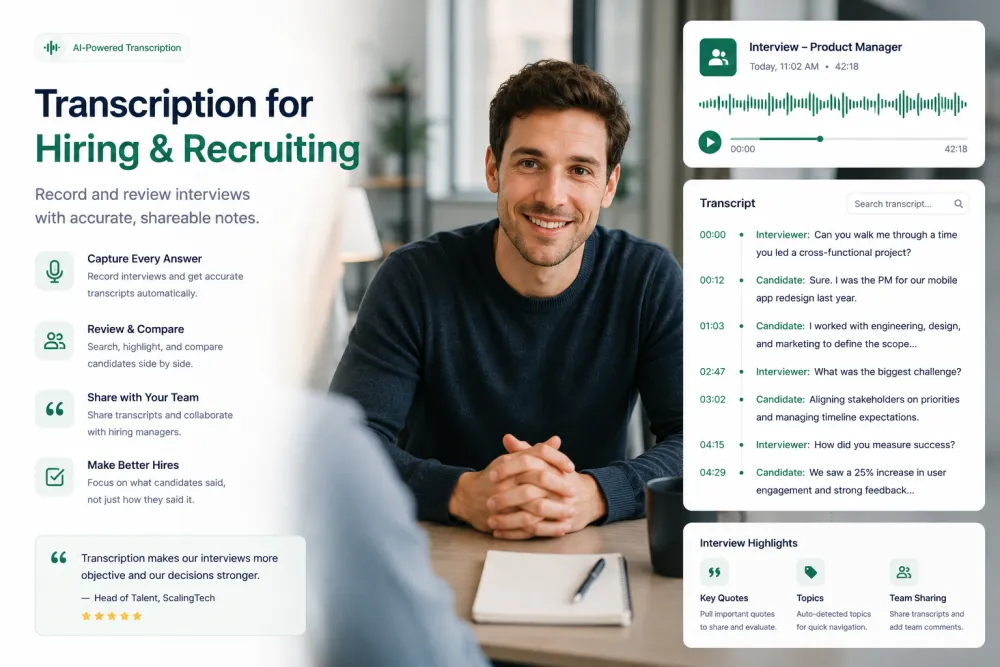
A short excerpt from a recorded technical screen, and the kind of notes the AI produces from the full interview.
Illustrative example. The AI summarizes what was actually discussed rather than filling a fixed template — and it does not add an assessment, a score, or a hiring recommendation of its own.
What You Can Capture From an Interview
Depending on how the interview went, the transcript and AI notes can help your team identify:
Interview Notes Before and After a Transcript
The same interview, written up two ways.
What AI Interview Transcription Gives Your Hiring Team
Speaker-Labeled Interview Transcripts
Know exactly what the candidate, the recruiter, the hiring manager, and each panel member said. Panel interviews are the hardest recordings to review by ear and the easiest to read once every speaker is separated.


AI Interview Summaries
Skip replaying a one-hour interview. The summary covers relevant experience, the answer to each question, concerns raised, and what the candidate asked — with the full transcript underneath so every line traces back to the moment it was said.
Export Interview Notes
Export the transcript and notes as DOCX, PDF, TXT, SRT, or VTT and attach them to the hiring file, paste them into your ATS, or send them to a hiring manager who could not attend.

Interview Notes Written From the Recording, Not From Memory
An interview summary condenses a long conversation into what the hiring team needs next: what the candidate has done, how they answered, what they were unsure about, and what nobody got to ask.
TranscribeThis produces both the full searchable transcript and a concise summary, so the debrief happens the same day and the scorecard is filled in from evidence rather than from an hour-old impression.
Relevant experience
What the candidate has actually done, described in their own words and searchable afterwards.
Answers to the questions asked
Each question and the substance of the reply, timestamped for review.
Concerns and constraints
What the candidate raised about the role, the team, notice, or working arrangements.
Open threads for the next round
What was not covered, so the next interviewer does not repeat the same ground.
From Interview Recording to Hiring Decision
Works with recordings from Zoom, Teams, Google Meet, Webex, or a phone.
Tell the candidate the interview is being recorded, record it with the tool you already use, then drop the file in — MP4 from Zoom or Teams, M4A from a phone, MP3 from a conferencing export.
You get a speaker-labeled transcript with clickable timestamps, plus notes covering experience, answers, concerns, and candidate questions.
Fill the scorecard from the transcript, share it with everyone on the panel, and compare candidates against the same questions instead of against each interviewer’s memory.
Works With Zoom, Teams, Google Meet, and Webex
Zoom interviews
Upload an MP4, M4A, or audio-only recording exported from Zoom and receive a searchable transcript with speaker labels and timestamps.
Microsoft Teams
Convert recorded Teams interviews into notes the recruiter, the hiring manager, and the panel can all read.
Google Meet
Upload a Meet recording to create a full interview transcript and summary.
Webex and other conferencing tools
Any interview recording that exports to a standard audio or video format can be uploaded as-is.
Phone screens and dialer recordings
Upload MP3, WAV, M4A, or another supported format from a phone screen or call recording system.
Slack Huddles and screen recordings
Recorded huddles and one-way candidate videos transcribe the same way as live interviews.
TranscribeThis processes recordings you upload; on Standard and Premium, its bot can also join and record Zoom, Google Meet, or Microsoft Teams interviews. Either way, tell the candidate first; for other platforms or phone screens, record with the tool you already use, then upload the file.
The Hiring Workflow, End to End
Each step is something a hiring team already does — the transcript is what makes the record survive to the decision.
- Upload interview
- Automatic transcription
- Speaker identification
- AI interview summary
- Compare candidates
- Export notes
- Hiring decision
What Goes Wrong Between the Interview and the Decision
Hiring mistakes are rarely made in the interview. They are made in the gap between the interview and the write-up.
An interviewer typing is an interviewer not following up. The question that would have tested the answer goes unasked because they were mid-sentence in a notes field.
By the debrief, "I think they said" has become "they said". Without a record, the most confident recollection wins the argument rather than the most accurate one.
One candidate is remembered in detail because they were interviewed on Tuesday; another is a blur because they were the fourth on Thursday. That is a scheduling artifact deciding a hire.
Why Recruiters Choose AI Transcripts Over Handwritten Notes
| Handwritten notes | AI interview transcript |
|---|---|
| Missed answers — written while trying to listen | Everything captured from the complete recording |
| Depend on memory at the debrief | Searchable in seconds, by keyword or candidate |
| Subjective paraphrase of what was said | Exact wording, in the candidate’s own words |
| Manual write-up after every round | AI summary of experience, answers, and concerns |
| No timestamps — nothing to point at | Timestamped, so any answer replays in one click |
| Vary in depth from interviewer to interviewer | Every candidate evaluation rests on the same record |
Interview Transcription for Every Hiring Stage
Every stage where the decision will be argued afterwards by people who were not all in the room.
The screening interview sets the shortlist. A transcript means the hiring manager reads what was said instead of a recruiter’s three-line summary.
Four interviewers, one candidate, and four different recollections. Speaker labels make the record readable and shared.
System design and architecture answers are exactly what paraphrasing damages. The transcript keeps the reasoning intact.
Senior hires are decided by people who attended different conversations. One searchable record makes the final discussion possible.
A behavioral interview turns on a specific past example. Paraphrase loses the detail that made the example convincing.
Structured evaluation only works if every candidate is measured on the same answers — which requires the answers to still exist.
The debrief runs on evidence rather than on who remembers most confidently.
What a former manager says is worth keeping verbatim, with the caveats they attached to it.
Distributed panels rarely interview together. A transcript lets a colleague in another timezone review properly.
What This Is — and What It Deliberately Is Not
TranscribeThis transcribes and summarizes interviews you record and upload. It gives every interviewer the same evidence and makes a structured process practical rather than aspirational.
It does not score candidates, rank a shortlist, predict performance, or recommend a hire. That is a design decision, not a missing feature: automated assessment of applicants carries legal obligations in a growing number of jurisdictions, and hiring judgement should sit with people who can be asked to justify it.
Recording an interview also has rules. Consent requirements differ by country and by US state, and in the EU and UK a recorded interview is personal data with retention limits attached. Tell candidates before you record, and check your own obligations — this page is not legal advice.
Compare Candidates Faster
Search exactly where each candidate answered. Review every interview against the same questions. This is a structured comparison built from three searchable transcripts instead of three sets of notes — you assemble it, the AI does not.
| Candidate A | Candidate B | Candidate C | |
|---|---|---|---|
| Incident ownership | Owned rollback for a six-hour outage; approved the migration that caused it | Described team response; own role not specified when asked twice | Was on call but escalated within ten minutes; explained why |
| System design answer | Staged rollout, no discussion of failure modes | Named three failure modes unprompted; weaker on data modelling | Strong on data modelling; did not reach failure modes in the time |
| Questions they asked | How design review works on this team | Team size, on-call rotation, promotion process | None recorded before time ran out |
| Constraints stated | Two months’ notice | Needs remote two days a week | Available immediately |
| Not covered | Depth of the staged-rollout design | Data modelling | Candidate’s own questions |
Illustrative. TranscribeThis produces the transcripts and summaries; building the comparison, weighing the answers, and making the decision are yours. There is no candidate scoring or ranking feature, by design.
Export Interview Notes to Your ATS
Interview notes and transcripts export as DOCX, PDF, TXT, SRT, or VTT, and the summary is built to be pasted straight into a candidate record.
To be clear about how this works: there is no direct ATS integration and nothing syncs automatically. Notes are designed to be copied into any ATS field or attached to the candidate record as an exported file — which is why the list above is open-ended rather than a set of supported connectors.
Interview Notes Template
The structure our summaries follow, and a usable scorecard whether or not you transcribe the interview with us.
Interview Recordings Are Personal Data
An interview recording contains an identifiable person discussing their career. Handling it carelessly is both a privacy problem and a legal one.
Uploads travel over TLS and are stored encrypted.
Guest uploads that aren't saved to an account are deleted automatically; files in your account stay until you delete them or your retention setting removes them, which matters when a policy sets a deletion date.
Candidate interviews are not training data.
Consent rules vary by country and by US state. Notifying the candidate is your responsibility, and it is good practice everywhere.
Interview Documentation Explained
What are AI interview notes?
AI interview notes are a structured summary generated from an interview recording, covering the candidate’s relevant experience, their answers to the questions asked, concerns they raised, and questions they asked. They shorten the write-up; they do not replace the interviewer’s judgement.
What is an interview transcript?
An interview transcript is the full written record of a job interview, with speaker labels and timestamps so any answer can be found and replayed. It is the evidence a hiring debrief can be checked against.
What is a structured interview?
A structured interview asks every candidate for a role the same core questions and evaluates the answers against defined criteria. Research on selection methods has consistently found structured interviews to be more predictive than unstructured ones — and transcripts are what make the comparison auditable in practice.
What is speaker diarization?
Speaker diarization automatically separates the people in a recording and labels who said what. In a panel interview it is what distinguishes a candidate’s claim from an interviewer’s prompt.
Supported Formats, Languages, and Limits
Interview Transcription: The Numbers
| Up to 99% | Accuracy on clear, well-recorded interviews |
|---|---|
| 90+ | Languages transcribed and translated |
| ~2 min | Typical processing for a one-hour interview |
| Until you delete | File retention in your account |
Accuracy and processing time vary with recording quality, background noise, speaker overlap, accents, language, and interview length.
What Affects Transcription Quality
Accuracy is not a fixed number. These are the conditions that move it, in rough order of impact:
Hiring and Interview Glossary
- Structured interview
- An interview where every candidate is asked the same core questions and assessed against defined criteria.
- Panel interview
- An interview conducted by several interviewers at once, usually with different areas to probe.
- Screening interview
- The first conversation, usually with a recruiter, that decides whether a candidate goes forward.
- Technical interview
- A round focused on demonstrating skill — system design, coding, or domain problem-solving.
- Scorecard
- The form an interviewer completes after a round, recording evidence against each requirement.
- Debrief
- The meeting where interviewers compare what they heard and reach a decision.
- Hiring manager
- The person the role reports to, who owns the final hiring decision.
- ATS
- Applicant tracking system — the software a company uses to manage candidates through the process.
- Candidate evaluation
- Assessing a candidate against the defined requirements of the role, using evidence from the interview.
- Behavioral interview
- An interview asking for specific past examples rather than hypotheticals, on the theory that past behavior predicts future behavior.
- Interview loop
- The full sequence of rounds a candidate goes through for one role.
- Candidate experience
- How the process feels from the applicant’s side, including clarity, speed, and being told what happens next.
- Speaker diarization
- Automatically separating and labelling who is speaking in a recording.
- Time to hire
- How long it takes from a candidate entering the process to accepting an offer.
- Interview bias
- Judgement influenced by something other than the evidence — including how well an interviewer happens to remember one candidate over another.
Who Uses Interview Transcription?
Try It With a Real Interview
Upload a recording and review the transcript, speaker labels, timestamps, and AI notes before choosing a paid plan. No signup for files up to 50 MB.
Related Pages
Frequently Asked Questions
Can AI transcribe Zoom interviews?
Yes. Record the interview in Zoom — after telling the candidate — and upload the MP4 or audio-only export. Teams, Google Meet, Webex, and phone recordings work the same way. You get a searchable, speaker-labeled transcript with clickable timestamps and a summary in minutes, in the browser, with nothing to install.
How accurate is interview transcription?
Accuracy reaches up to 99% on clear, well-recorded interviews. Conference-room microphones, overlapping questions, and strong accents reduce it. Recording quality matters far more than file format, and it is worth checking the transcript before treating a garbled line as something the candidate actually said.
Can AI identify interview speakers?
Yes. Speaker labels separate the candidate from each interviewer automatically, which is what makes a four-person panel readable afterwards. Heavy interruption reduces accuracy, so a recording where people talk over each other will need more checking.
Can I upload Google Meet recordings?
Yes. Upload the recording Google Meet saves to Drive. Zoom, Teams, Webex, and phone screens work identically — over 30 audio and video formats are supported, so no conversion is needed.
Does it support Microsoft Teams?
Yes. Download the recorded Teams interview and upload it. Over 30 audio and video formats are supported, so no conversion is needed.
Does TranscribeThis join interviews automatically?
Not on its own — only when you send it. On Standard and Premium, the TranscribeThis bot can join and record Zoom, Google Meet, or Microsoft Teams interviews — it joins as a participant and may wait to be admitted, and the transcript arrives after the call, not live. Tell the candidate before you record. For other platforms or phone screens, record with your own tool and upload the file.
Does the AI score or rank candidates?
No, and this is deliberate. The summary reports what was said — experience, answers, concerns, questions — without adding an assessment, a rating, or a hiring recommendation. Automated evaluation of applicants carries legal obligations in a growing number of jurisdictions, and the judgement belongs with the people accountable for it.
Can I export interview notes as DOCX or PDF?
Yes — export as DOCX, PDF, TXT, SRT, or VTT, then attach the file to the hiring record or paste the notes into your ATS.
Can I export interview notes to my ATS?
You can paste or attach them, but nothing syncs automatically — there is no direct ATS integration today. Copy the summary into any field in Greenhouse, Lever, Ashby, Workday, BambooHR, or Jobvite, or attach the exported DOCX or PDF to the candidate record.
Can recruiters search interview transcripts?
Yes. The full interview is searchable by keyword, and clicking a line jumps the audio to that moment — useful when a debrief turns on exactly how an answer was phrased. Export or share the transcript so the whole loop searches one record instead of comparing several recollections.
Can I compare candidates?
You can compare them properly, using searchable transcripts of the same questions — but the comparison is yours to build. There is no candidate comparison feature, no scoring, and no ranking, by design. What the product gives you is every candidate’s answers in the same searchable form, which is what makes a fair comparison possible at all.
Can I translate an interview?
Yes — 90+ languages are detected automatically, and supported transcripts can be translated from the editor in your account, so a panel can review an interview conducted in another language.
How long can an interview be?
Free uploads are limited to 50 MB per file, which is roughly an hour of compressed audio; longer interviews and larger video files need a paid plan. A one-hour recording typically processes in about two minutes.
Do I need the candidate’s consent to record an interview?
Usually yes, and the rules differ by country and by US state — some require all parties to consent. In the EU and UK an interview recording is personal data with retention obligations attached. Tell candidates before you record, explain what happens to the recording, and check your own legal obligations. This is not legal advice.
Details on encryption, retention, and how we handle your files: Privacy Policy · Terms of Service
Reviewed by the TranscribeThis Speech Recognition Team.
Last updated: July 2026